
IGC at PRAGMA: Turning Grid Bottlenecks Into Investment Strategy
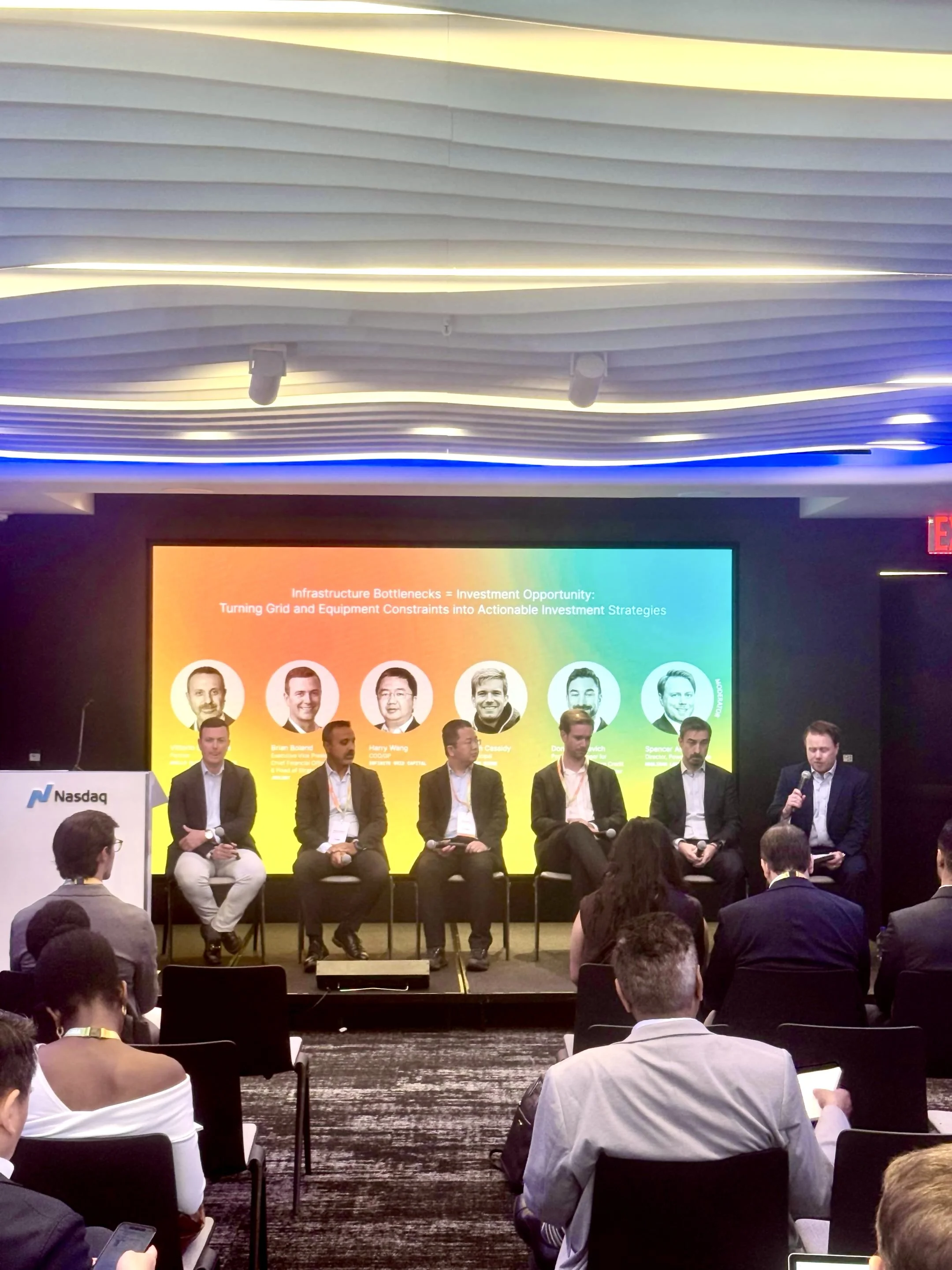
Last week, Infinite Grid Capital's COO and General Partner, Harry Wang, joined PRAGMA's New York Energy Investment Series at Nasdaq MarketSite in Times Square, as part of a panel on "Infrastructure Bottlenecks = Investment Opportunity: Turning Grid and Equipment Constraints into Actionable Investment Strategies." Here's where Harry — and IGC — landed on the conversation's key questions.
The Bottleneck Has Moved to the Grid Interface
Asked how the binding constraint on battery storage compares to thermal generation, Harry pointed to a shift the market hasn't fully priced in: the battery containers themselves are rarely the bottleneck anymore. Interconnection determines whether a project has a viable location, and permitting determines whether it can be built — but energization and commissioning determine when it actually starts earning money. The market, he noted, is good at financing equipment and still underestimates how much value gets trapped between mechanical completion and commercial operation.
Own the Megawatt, Control the Bottleneck
On whether IGC would rather own generation or the supply chain behind it, Harry's answer became the line of the panel:
"own the megawatt, but control the bottleneck."
IGC still wants the generation economics — contracted cash flow, tax attributes, locational value — but has moved away from treating equipment procurement as a passive assumption. Our preferred model is strategic alignment with manufacturers: giving them visibility into IGC's project pipeline in exchange for priority access and delivery certainty, sometimes with the manufacturer investing alongside the project. As Harry put it,
"temporary component shortages produce trading opportunities; structural process bottlenecks produce durable businesses."
Private Credit Should Solve Timing, Not Underwrite Risk
Harry drew a clear line on structured capital: private credit works well when it bridges a defined timing gap — equipment deposits due before construction debt is available — but gets expensive fast when it's asked to underwrite unresolved development or interconnection risk instead. In his words:
"Private credit is most effective when it finances a timing mismatch, not when it disguises an underwriting gap."
Speed Only Earns a Premium When It's Paid For
On fast-build and modular solutions, Harry's view cut against some of the hype: the real speed advantage comes from reusing existing interconnection rights and infrastructure, not from modular hardware alone. Speed only justifies a premium when it's contractually monetized — an earlier tolling date, a capacity payment, a data-center obligation. Otherwise, it just means taking on risk earlier.
The Takeaway
Asked to name the sector's biggest overlooked risk, Harry's answer summed up the day: power demand isn't the question anymore — the ability to convert that demand into a reliable energization date is.
Thank you to PRAGMA for hosting, and to moderator Spencer Anderson of Houlihan Lokey and fellow panelists for the discussion.
